Standard Penetration Test refers to a field procedure used to evaluate soil resistance through controlled sampling and measured driving blows. The Standard Penetration Test plays a major role within geotechnical soil investigation because it provides direct insight into subsurface strength, density, and variability across different soil layers.
Standard Penetration Test results help engineers interpret ground behavior before any foundation work begins. Data collected from this test supports decisions related to structural design, load distribution, and settlement control. Standard Penetration Test findings also guide construction teams when selecting foundation types suitable for specific site conditions.
Standard Penetration Test remains one of the most widely applied methods for subsurface evaluation due to its practicality and reliability across a wide range of soil types.
Importance of Standard Penetration Test for Construction Projects
Standard Penetration Test holds high value for construction planning across regions where soil conditions vary significantly and seismic activity presents design challenges. Within Philippine construction environments, soil layers may shift from soft clay to dense sand within short distances, making site-specific testing essential.
Standard Penetration Test helps identify weak soil zones that may not support structural loads. Without Standard Penetration Test data, structures may experience uneven settlement, tilting, or foundation distress over time.
Standard Penetration Test also supports cost control during design. Engineers can avoid excessive structural overdesign when accurate soil strength data is available. At the same time, Standard Penetration Test prevents underdesign, which may lead to structural failure or costly repairs.
Standard Penetration Test findings provide critical input for residential buildings, commercial complexes, bridges, roads, and other infrastructure developments where foundation stability is a primary concern.
Process of Standard Penetration Test
Standard Penetration Test follows a controlled field procedure that ensures consistent and comparable results across different sites.
Borehole Preparation
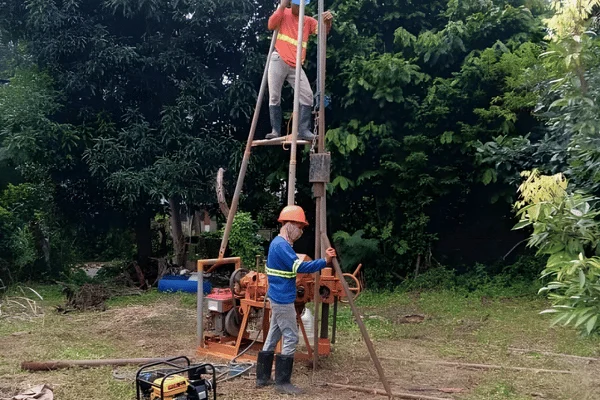
Standard Penetration Test begins with drilling a borehole to reach the target investigation depth. The borehole is cleaned carefully to remove loose material that may affect accuracy. Proper preparation ensures that Standard Penetration Test results reflect actual soil conditions at each depth level.
Split Spoon Sampling Method
Standard Penetration Test uses a split spoon sampler placed at the bottom of the borehole. A standard hammer with a fixed weight is dropped from a specific height to drive the sampler into the soil.
The number of hammer blows required for penetration is recorded at intervals. This process forms the basis of Standard Penetration Test measurement.
N-Value Determination
Standard Penetration Test results are expressed as an N-value. This value represents resistance based on hammer blows required to drive the sampler through a defined soil depth.
Higher N-values from the Standard Penetration Test indicate denser and stronger soil. Lower N-values indicate softer or weaker soil layers. Engineers rely on Standard Penetration Test N-values to classify soil strength and estimate bearing capacity.
Interpretation of Standard Penetration Test Results
Standard Penetration Test data requires careful interpretation to support engineering design. Soil layers are classified based on resistance levels observed during testing.
Loose soil conditions identified through Standard Penetration Test may require deep foundations or soil improvement techniques. Medium density results from Standard Penetration Test may support shallow foundations depending on structural load. Dense soil layers indicated by Standard Penetration Test often provide strong bearing capacity suitable for direct foundation support.
Standard Penetration Test also helps detect transitions between soil layers. Sudden changes in N-values during Standard Penetration Test may indicate shifts from stable material to weaker zones. These transitions are important for foundation planning and structural safety evaluation.
Soil Conditions Evaluated Through Standard Penetration Test
Standard Penetration Test is effective across a wide range of soil types commonly encountered during construction.
Soft clay layers are frequently identified through low resistance values from Standard Penetration Test. These layers often require special foundation solutions due to compressibility.
Sandy soils evaluated through Standard Penetration Test may show varying density levels. Loose sand conditions may present liquefaction risk during seismic events, while dense sand typically provides strong support capacity.
Mixed soil profiles also benefit from Standard Penetration Test because variations in resistance help define safe foundation depth. Fill materials and disturbed ground conditions are also assessed through Standard Penetration Test to confirm stability before construction.
Standards Applied for Standard Penetration Test
Standard Penetration Test follows established international and national standards to ensure accuracy and consistency.
ASTM standards provide detailed procedures for conducting Standard Penetration Test and interpreting results. These standards define equipment specifications, sampling methods, and testing protocols.
AASHTO guidelines also support Standard Penetration Test applications, particularly for infrastructure and transportation projects where soil performance directly affects structural reliability.
Within local construction regulations, DPWH requirements guide the implementation of Standard Penetration Test for public and private projects. These requirements ensure that soil investigation results meet safety and design standards expected for construction approval.
Role of Standard Penetration Test in Structural Safety
Standard Penetration Test plays a central role in ensuring structural safety by providing reliable soil data before foundation design begins.
Foundation performance depends heavily on accurate understanding of soil behavior. Standard Penetration Test results help engineers determine whether soil can support expected loads without excessive settlement.
Standard Penetration Test also supports risk reduction by identifying weak or unstable soil layers early. Early detection allows design adjustments that improve long-term structural stability.
Cost efficiency is another benefit of Standard Penetration Test. Accurate soil profiling reduces unnecessary construction adjustments during execution, saving both time and resources.
Standard Penetration Test Services by Inch-On Materials Testing Laboratory
Inch-On Materials Testing Laboratory provides complete geotechnical services centered on Standard Penetration Test for construction projects requiring reliable subsurface data.
Services related to Standard Penetration Test include field drilling operations, borehole logging, soil sampling, and N-value recording. The laboratory performs Standard Penetration Test across various project types such as residential developments, commercial buildings, roads, bridges, and industrial facilities.
Standard Penetration Test reports prepared by the laboratory support engineers and project developers during planning and design stages. Each Standard Penetration Test output is prepared according to recognized standards and project requirements.
The laboratory also performs supporting soil and construction material evaluations that complement Standard Penetration Test results. These combined services help create a complete understanding of site conditions before construction work begins.
Field Testing and Laboratory Testing in Standard Penetration Test Programs
Standard Penetration Test programs include both field and laboratory components that work together to form a complete geotechnical profile.
Field testing focuses on actual site conditions. Standard Penetration Test is performed directly at the borehole location, capturing real-time soil resistance and stratification. Field observations during Standard Penetration Test help identify moisture conditions, soil changes, and depth-related variations.
Laboratory testing supports Standard Penetration Test findings through controlled analysis of collected soil samples. These tests confirm soil classification, strength characteristics, and physical properties.
Combination of field-based Standard Penetration Test results and laboratory data creates a reliable foundation for engineering design decisions.
Applications of Standard Penetration Test in Construction Projects
Standard Penetration Test is applied across multiple construction sectors.
Residential projects rely on Standard Penetration Test to confirm safe footing depth and prevent settlement issues in housing developments.
Commercial buildings depend on Standard Penetration Test for foundation design that supports higher structural loads.
Infrastructure projects such as roads and bridges use Standard Penetration Test data to evaluate subgrade stability and long-term performance.
Industrial facilities require Standard Penetration Test to ensure soil can support heavy equipment and operational loads.
Advantages of Standard Penetration Test
Standard Penetration Test provides several advantages for geotechnical investigation.
It offers a direct measurement of soil resistance under controlled conditions. Standard Penetration Test is widely accepted across engineering practices, making results easy to interpret and apply.
Standard Penetration Test is suitable for a wide range of soil conditions, including clay, sand, and mixed layers. It also supports comparison across multiple boreholes, helping engineers map soil variability across a site.
Standard Penetration Test results can be correlated with bearing capacity estimates, making it valuable for preliminary and detailed design stages.
Takeaway
Standard Penetration Test remains a core component of geotechnical soil investigation for construction projects that demand safety, stability, and long-term performance. Accurate Standard Penetration Test results guide engineers in designing foundations that match actual ground conditions.
Reliable Standard Penetration Test services provided by experienced laboratories such as Inch-On Materials Testing Laboratory support informed decision-making across residential, commercial, and infrastructure developments. Standard Penetration Test continues to play a critical role in reducing structural risks and improving construction outcomes across diverse soil environments.
Frequently Asked Questions about Standard Penetration Test
What does Standard Penetration Test measure?
Standard Penetration Test measures soil resistance during sampling through recorded hammer blows, producing an N-value used for soil strength evaluation.
Why is Standard Penetration Test important before construction?
Standard Penetration Test provides essential data on soil conditions that support safe foundation design and reduce structural risks.
How deep does Standard Penetration Test go?
Standard Penetration Test depth depends on project requirements and soil conditions encountered during drilling operations.
Is Standard Penetration Test required for building approval?
Standard Penetration Test is often required for permit applications and structural design compliance under construction regulations.
Can Standard Penetration Test identify weak soil layers?
Standard Penetration Test can detect variations in soil resistance that indicate weak or unstable layers requiring special foundation solutions.