Reliable construction depends on careful material selection, proper installation, and accurate testing. Grout can play an important role across masonry, structural connections, foundations, equipment bases, and other construction applications. When grout quality does not meet project requirements, the resulting concerns may affect strength, durability, service performance, and construction quality.
Grout integrity testing Philippines provides project teams with a way to evaluate grout-related quality requirements through appropriate sampling, testing, inspection, and technical documentation. The exact testing procedure depends on the grout type, intended application, project specifications, and applicable standards.
For contractors, developers, civil engineers, structural engineers, and quality-control teams, working with a qualified materials testing laboratory can provide useful technical information for construction decisions.
In the Philippines, Inch-On Materials Testing Laboratory provides independent construction material testing and field testing services. The laboratory was established in November 2018 and is accredited by the Department of Public Works and Highways – Bureau of Research and Standards (DPWH-BRS). Its documented testing work covers soil, concrete, foundation piles, aggregates, reinforced steel products, concrete hollow blocks, and other construction materials, following applicable ASTM and AASHTO standards.
What Is Grout Integrity Testing?
Grout integrity testing refers to the evaluation of grout quality, condition, strength, or performance using test procedures appropriate for a particular construction application.
Grout may serve different purposes depending on a project’s design. It can fill spaces, surround reinforcement, support structural elements, connect components, or provide a solid material around specific construction assemblies. Because applications vary, the correct testing approach should always be selected according to project requirements.
A Grout integrity testing Philippines program may involve several quality-control activities, such as representative sampling, specimen preparation, laboratory testing, field observations, non-destructive evaluation, or other procedures specified by the project engineer.
The objective is not simply to produce a test number. Good testing provides technical information that engineers and construction professionals can compare against specified requirements.
Testing may help answer important questions:
- Does the tested material meet the required strength?
- Was the sample representative of the material being evaluated?
- Were specimens prepared and cured correctly?
- Are there indications of voids, discontinuities, or other defects where applicable?
- Does the tested material correspond with the project specification?
- Are additional evaluations necessary?
A qualified laboratory can help establish the appropriate testing path based on the project scope.
Why Is Grout Integrity Important for Construction Projects?
Grout quality can have a direct relationship with the performance expected from a construction assembly. A material may appear acceptable visually while still requiring technical evaluation to verify its properties.
That is why Grout integrity testing Philippines can be an important part of construction quality control.
Structural Performance
Certain grout applications are designed to transfer loads, fill structural spaces, surround reinforcement, or provide support between construction components. The specified properties of the grout therefore need to match the intended application.
Testing can provide measurable information that helps engineers evaluate whether the tested material satisfies applicable requirements.
Construction Quality Control
Quality control requires more than visual inspection. Laboratory results can provide objective measurements that supplement site observations and construction records.
For projects with defined grout-strength requirements, testing can help project teams document whether tested samples meet those requirements.
Early Identification of Quality Concerns
Testing can help identify potential material concerns before they become more difficult to investigate.
A result that does not meet the specified requirement may lead the responsible engineer or project team to conduct additional investigation, review placement records, examine curing conditions, or determine an appropriate corrective action.
Technical Documentation
Construction projects require reliable records. Test reports can document sample information, test procedures, measured results, and other relevant details.
Such records can support communication between contractors, engineers, developers, inspectors, and project owners.
What Can Affect Grout Integrity?
Several factors can influence grout quality. Grout integrity testing Philippines should therefore be considered alongside proper material handling, placement, curing, and construction practices.
Important factors include:
Material Proportions
The proportions of cementitious materials, aggregates, water, admixtures, or other specified components can affect grout properties. Project teams should follow the approved mix design and manufacturer’s or engineer’s requirements where applicable.
Water Content
Excessive or insufficient water can affect workability and hardened properties. Water addition should follow the approved procedure rather than informal site adjustments.
Mixing Procedures
Proper mixing helps produce a consistent material. Mixing duration, equipment, sequence, and batching procedures may all affect consistency.
Placement
Poor placement can contribute to voids, segregation, incomplete filling, or other concerns. Proper placement procedures should match the application and project requirements.
Consolidation
Certain grout applications require appropriate consolidation to reduce unwanted voids and improve contact with surrounding elements.
Curing
Curing conditions can significantly affect strength development. Test specimens should receive the curing treatment specified by the applicable standard or project requirements.
Site Conditions
Temperature, moisture, exposure, access, and surrounding construction conditions may also affect placement and performance.
Because so many factors can affect grout quality, laboratory results should always be reviewed alongside relevant project records and engineering requirements.
Common Testing Considerations for Grout Quality
The correct testing program depends on the specific grout application. A professional Grout integrity testing Philippines service should therefore begin with a review of the project’s specifications and required test methods.
Compressive Strength
Compressive-strength testing can provide quantitative information about the ability of a cementitious material to resist compressive loading when the applicable testing procedure calls for such evaluation.
Proper sampling, specimen preparation, curing, equipment, loading procedures, and reporting all matter when producing useful results.
The required acceptance value should come from the project specification, design documents, applicable standard, or responsible engineer rather than from a generic value applied to every grout application.
Sampling and Specimen Preparation
Representative sampling is essential. A test result is only useful when the sample properly represents the material or construction condition being evaluated.
Specimens should be prepared according to the applicable procedure, with careful attention to dimensions, identification, handling, and curing.
Curing Conditions
Curing affects the development of cementitious material properties. Test specimens need suitable curing conditions for the selected test procedure.
Testing records should clearly identify relevant specimen information so project professionals can interpret the results correctly.
Field Observations
Laboratory testing can be supplemented by field observations. Site conditions, placement practices, visible defects, and construction records may provide useful context when evaluating a grout-related concern.
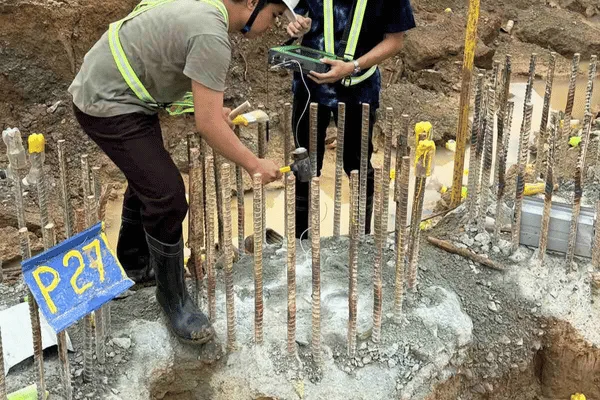
For projects requiring non-destructive evaluation of concrete or other structural elements, Inch-On also provides field testing services such as Ultrasonic Testing and Rebound Hammer Testing. Its Ultrasonic Testing service can evaluate concrete uniformity and identify internal voids or cracks through applicable ultrasonic methods.
Grout Integrity Testing Philippines and ASTM Standards
Recognized testing standards provide a consistent framework for material evaluation.
Inch-On Materials Testing Laboratory states that its testing services follow ASTM and AASHTO standards, with DPWH-BRS accreditation supporting its work as an engineering and construction laboratory.
ASTM and AASHTO standards may address different materials and testing procedures. The appropriate standard should therefore be selected based on the material, application, and project requirements.
For Grout integrity testing Philippines, this distinction matters. Not every grout application requires the same test method, specimen type, testing age, or acceptance criterion.
Project engineers and testing laboratories should review the applicable documents before testing begins.
How Grout Testing Fits Into Construction Quality Control
A structured testing workflow can help project teams manage material verification more effectively.
Step 1: Review Project Specifications
Start by identifying the grout type, required strength, intended use, sampling requirements, testing frequency, acceptance criteria, and applicable standards.
Step 2: Collect Representative Samples
Samples should be collected according to the approved procedure. Proper identification and handling help preserve the connection between the sample and its project location or batch.
Step 3: Prepare and Cure Test Specimens
Specimens should be prepared, labeled, and cured according to the applicable testing method.
Step 4: Conduct Laboratory Testing
The selected laboratory test should follow the appropriate standard and project requirements.
Step 5: Analyze Test Results
Measured results should be compared with the applicable project criteria.
Step 6: Prepare Technical Reports
A clear report should document relevant sample details, test methods, results, and other required information.
Step 7: Address Quality Concerns
If a result does not meet the specified requirement, the responsible engineer or project authority can determine whether additional testing, investigation, engineering assessment, or corrective action is necessary.
This structured approach gives Grout integrity testing Philippines a practical role within broader construction quality management.
Why Choose a Qualified Materials Testing Laboratory?
Construction material testing requires appropriate procedures, equipment, personnel, documentation, and quality controls.
A qualified laboratory can provide several advantages:
- Standardized testing procedures
- Appropriate laboratory equipment
- Controlled specimen preparation
- Proper sample identification
- Technical reporting
- Field-testing capabilities
- Laboratory-testing capabilities
- Experience with construction materials
- Testing aligned with applicable standards
- Support for project quality-control documentation
Choosing a laboratory should involve more than comparing prices. Project teams should also examine accreditation, relevant testing capabilities, reporting practices, applicable standards, and the laboratory’s ability to support the project’s technical requirements.
Inch-On Materials Testing Laboratory for Construction Material Testing
Inch-On Materials Testing Laboratory is a DPWH-BRS accredited Engineering and Construction Laboratory established in November 2018. The company provides independent testing focused on soil and construction materials, along with in-situ testing of soil, concrete, and foundation piles.
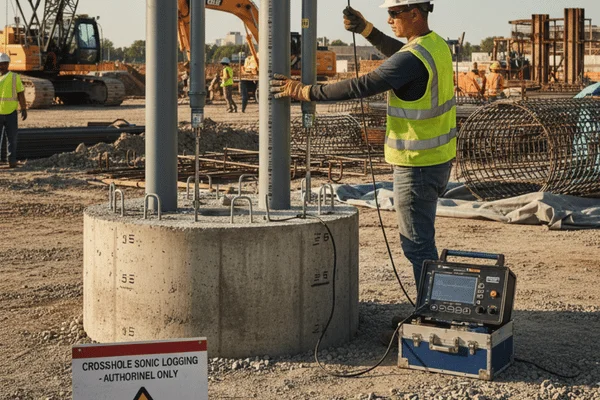
Its published laboratory services include testing for coarse aggregates, fine aggregates, asphalt, soil, reinforced steel bars and products, and concrete hollow blocks. Its field-testing services include Field Density Testing, Rebound Hammer Testing and Rebar Scanning, Pile Integrity and Dynamic Testing, Crosshole Sonic Logging, Standard Penetration Testing, and Ultrasonic Testing.
This broad testing capability provides project teams with access to different forms of material and structural evaluation.
For Grout integrity testing Philippines, this broader capability can be useful when a grout-related concern overlaps with concrete quality, structural assessment, foundation conditions, or other construction material questions.
Laboratory Testing and Field Testing for Construction Projects
Laboratory Testing
Laboratory testing provides controlled conditions for evaluating construction materials.
Inch-On describes its laboratory services as quality testing of soil and construction materials using specialized apparatus and standardized procedures.
Laboratory conditions allow technicians to manage specimen preparation, testing equipment, measurement, and reporting under controlled procedures.
Field Testing
Field testing evaluates selected materials or structural elements directly at the project site.
Inch-On provides in-situ testing for soil, concrete, and foundation piles. Its field services include several non-destructive and integrity-focused methods.
Field information can be valuable because actual construction conditions may differ from controlled laboratory conditions.
Combining Field and Laboratory Information
A construction project may require both laboratory and field information. Laboratory results can provide controlled material data, while field testing can provide information about actual installed conditions.
This combination can support more informed engineering review when the project scope requires it.
Benefits of Professional Grout Quality Testing
Professional Grout integrity testing Philippines can contribute to several areas of construction quality management.
Better Material Verification
Testing provides measurable data for comparison with project requirements.
Reliable Technical Information
Standardized procedures can produce results that engineers can review and document.
Improved Quality-Control Records
Formal reports provide useful documentation for construction records.
Early Identification of Potential Concerns
Testing can reveal results that warrant further investigation before a project reaches later construction stages.
Support for Engineering Decisions
Laboratory and field results can give engineers additional information when assessing construction quality.
Regulatory and Project Documentation
Testing performed according to applicable standards can support project documentation where such testing is required.
Better Communication
Clear reports allow contractors, engineers, developers, and project owners to work from documented technical information rather than visual observations alone.
When Should You Consider Grout Integrity Testing?
The need for Grout integrity testing Philippines depends on the construction application and project requirements.
Testing or evaluation may be considered for:
- New construction projects
- Reinforced masonry
- Structural grout applications
- Foundation-related work
- Grouted connections
- Equipment bases
- Construction quality-control programs
- Projects with specified grout-strength requirements
- Investigation of questionable test results
- Infrastructure projects requiring material verification
- Existing structures where grout-related concerns have been identified
The appropriate testing schedule should come from project specifications, engineering requirements, applicable standards, and the quality-control plan.
Questions to Ask Before Selecting a Grout Testing Laboratory
Selecting a testing laboratory deserves careful consideration.
Is the laboratory properly accredited?
Ask about relevant accreditation and the scope of services covered by that accreditation.
Inch-On Materials Testing Laboratory identifies itself as DPWH-BRS accredited.
Does the laboratory follow recognized standards?
Ask which ASTM, AASHTO, or other recognized procedures apply to the requested test.
Does the laboratory provide field and laboratory services?
A laboratory with both capabilities may be able to support projects that require material testing alongside field evaluation.
Are test reports clear?
Technical reports should provide sufficient information for qualified project professionals to understand the testing performed and the results obtained.
Does the laboratory have relevant construction-material experience?
Experience with concrete, aggregates, soil, steel, masonry products, and structural testing can be useful when several material questions arise within one project.
Grout Integrity Testing Philippines for Better Construction Decisions
Quality testing provides technical information that can support responsible construction decisions.
Grout integrity testing Philippines should not be treated as a single universal test. The proper procedure depends on the grout material, construction application, project specification, required property, and applicable standard.
A sound testing program can involve specification review, representative sampling, specimen preparation, controlled testing, field observations, data analysis, and technical reporting.
For projects where grout concerns overlap with concrete, foundation, or structural conditions, additional field or laboratory evaluations may also be appropriate.
Inch-On Materials Testing Laboratory provides independent laboratory and field testing services for construction materials and structural elements. The laboratory is DPWH-BRS accredited and states that its testing follows ASTM and AASHTO standards.
Why Partner With Inch-On Materials Testing Laboratory?
DPWH-BRS Accreditation
Inch-On Materials Testing Laboratory is accredited by the Department of Public Works and Highways – Bureau of Research and Standards. This accreditation is an important credential for projects requiring recognized laboratory testing services.
ASTM and AASHTO Standards
The laboratory follows applicable ASTM and AASHTO testing standards as part of its material testing services.
Laboratory and Field Capabilities
Its service portfolio covers both laboratory material testing and field-based evaluation. This includes construction materials as well as soil, concrete, and foundation pile testing.
Specialized Testing Equipment
Inch-On uses specialized equipment for its laboratory and field testing activities. Its published services include advanced methods such as Ultrasonic Testing, Crosshole Sonic Logging, Pile Integrity Testing, and other construction evaluation procedures.
Technical Reporting
Testing results are documented through technical reports that reflect the scope of testing performed. Such documentation can help project professionals review measured results against applicable requirements.
Frequently Asked Questions About Grout Integrity Testing Philippines
What is grout integrity testing?
Grout integrity testing involves evaluating grout quality, strength, condition, or related properties through an appropriate testing or inspection procedure. The exact method depends on the grout application and project requirements.
Why is grout testing important?
Grout testing can provide measurable information that supports construction quality control, material verification, engineering review, and project documentation.
What standards are used for grout testing?
The applicable standard depends on the material and test being performed. ASTM, AASHTO, project specifications, engineering documents, and other recognized requirements may apply.
Can grout testing be performed on-site?
Some evaluation methods can be performed directly at a project site, while other tests require controlled laboratory conditions. The appropriate approach depends on the property being evaluated.
How does laboratory testing support construction projects?
Laboratory testing provides controlled conditions for sample preparation and material evaluation. Results can then be compared with applicable project requirements.
Why choose a DPWH-BRS accredited laboratory?
A DPWH-BRS accredited laboratory provides testing under an established accreditation framework relevant to Philippine construction projects. Inch-On Materials Testing Laboratory identifies its accreditation with the DPWH-BRS.
Does Inch-On Materials Testing Laboratory provide construction material testing?
Yes. Inch-On’s published laboratory services include several construction-material testing categories, while its field services include soil, concrete, and foundation pile evaluation.
When should a contractor request grout testing?
Testing should be planned according to project specifications, quality-control requirements, engineering instructions, and applicable standards. A testing laboratory can review the project scope and help identify the appropriate testing procedure.
Can grout concerns require additional testing?
Yes. When test results or field observations indicate a potential concern, the responsible engineer or project authority may request additional evaluation. The appropriate next step depends on the nature of the concern and the project requirements.
Takeaway
Grout integrity testing Philippines can provide valuable technical information for construction quality control, material verification, and engineering assessment. Proper testing begins with understanding the grout application, project specifications, required properties, sampling requirements, and applicable standards.
Professional laboratory testing can provide controlled measurements, while field evaluation can provide information about actual construction conditions. Together, these services can support better documentation and more informed project decisions.
Inch-On Materials Testing Laboratory brings together laboratory and field testing capabilities, DPWH-BRS accreditation, specialized equipment, and testing procedures based on applicable ASTM and AASHTO standards.
For contractors, engineers, developers, and project owners seeking Grout integrity testing Philippines, the appropriate first step is to discuss the project specifications, grout application, required testing, and applicable standards with a qualified materials testing laboratory.
Need professional construction material testing? Contact Inch-On Materials Testing Laboratory to discuss your project requirements and determine the appropriate testing approach.