
Soil Testing plays a critical role in every construction project because the ground beneath a structure controls its stability, strength, and long-term performance. Soil Testing helps engineers understand how soil behaves under load, how much weight it can support, and how it reacts to moisture changes over time.
Without proper Soil Testing, construction projects face higher risks of settlement issues, cracking, foundation failure, and costly repairs. Reliable Soil Testing supports safe design decisions from early planning up to project completion. It gives engineers clear data about soil strength, composition, and classification, which directly influences foundation design and construction methods.
Modern construction depends heavily on accurate Soil Testing supported by recognized engineering standards such as ASTM and AASHTO. Accredited laboratories like Inch-On Materials Testing Laboratory provide reliable Soil Testing services that help engineers and contractors build safer and more durable structures.
What Soil Testing Means in Construction
Soil Testing refers to the process of evaluating soil properties to determine how it will perform under structural loads. This process includes both field evaluation and laboratory analysis. Soil Testing identifies key characteristics such as particle size, moisture content, plasticity, compaction behavior, and shear strength.
Soil Testing also helps classify soil types, which is essential for selecting suitable foundation systems. Different soils react differently when exposed to pressure, water, and environmental changes. Through Soil Testing, engineers gain a clearer understanding of site conditions before construction begins.
Soil Testing supports decision-making by reducing uncertainty in ground conditions. It allows engineers to design foundations that match the actual behavior of the soil, improving safety and long-term structural stability.
Importance of Soil Testing for Construction Projects
Soil Testing is essential because every structure depends on the strength of the ground beneath it. Even strong building materials cannot compensate for weak soil conditions. Soil Testing helps identify risks early, allowing engineers to adjust designs before construction starts.
One major benefit of Soil Testing is the prevention of structural settlement. When soil is not properly evaluated, uneven settlement may occur, leading to cracks in walls, floors, and foundations. Soil Testing reduces this risk by providing accurate soil strength data.
Soil Testing also helps control construction costs. Without proper Soil Testing, unexpected soil problems may appear during construction, leading to delays and additional expenses. Early Soil Testing supports better planning and reduces project uncertainties.
Another important aspect of Soil Testing is safety. Structures built on untested or poorly tested soil may face stability problems over time. Soil Testing provides the technical basis for safe engineering decisions.
Field Soil Testing Methods
Field Soil Testing involves direct evaluation of soil conditions at the construction site. This type of Soil Testing helps engineers understand real ground behavior without removing soil samples for laboratory analysis.
Field Soil Testing includes penetration tests that measure soil resistance. One widely used method is the Standard Penetration Test, which follows ASTM D1586. This Soil Testing method provides valuable data about soil density and strength at different depths.
Field Soil Testing also includes observation of groundwater conditions and soil consistency. Engineers use this information to assess whether the soil can support planned structural loads.
Field Soil Testing plays an important role in verifying design assumptions. Even when laboratory Soil Testing results are available, field verification ensures that actual site conditions match expected behavior.
Laboratory Soil Testing Methods
Laboratory Soil Testing involves controlled analysis of soil samples collected from the site. This type of Soil Testing provides detailed information about soil composition and engineering properties.
One common Soil Testing method in the laboratory is grain size analysis, which follows ASTM D422. This Soil Testing process determines the distribution of soil particles such as gravel, sand, silt, and clay. Particle size affects drainage, strength, and compaction behavior.
Another important Soil Testing method is the Atterberg Limits Test, based on ASTM D4318. This Soil Testing method measures soil plasticity and helps classify fine-grained soils. Plasticity results influence foundation design and soil stability evaluation.
Laboratory Soil Testing also includes moisture content determination and compaction testing. These Soil Testing procedures help engineers understand how soil behaves under different moisture conditions and loading scenarios.
Key Soil Properties Measured in Soil Testing
Soil Testing evaluates several important properties that affect construction performance. One of the main properties measured during Soil Testing is bearing capacity. Bearing capacity determines how much load the soil can support without failure.
Soil Testing also measures moisture content. Moisture levels affect soil strength and compaction behavior. High moisture content may reduce soil stability, while controlled moisture levels improve compaction results.
Plasticity is another key result of Soil Testing. Soil Testing identifies how soil changes shape when exposed to water and pressure. High plasticity soils may require special foundation designs.
Soil Testing also evaluates particle size distribution. This helps classify soil and determine drainage behavior. Well-graded soils generally perform better under structural loads compared to poorly graded soils.
How Soil Testing Supports Foundation Design
Soil Testing directly influences foundation design decisions. Engineers rely on Soil Testing results to determine whether shallow or deep foundations are required.
When Soil Testing shows strong and stable soil conditions, shallow foundations may be suitable. When Soil Testing reveals weak or compressible soil layers, deeper foundation systems may be necessary to reach stable ground.
Soil Testing also helps reduce settlement risks. By understanding soil compressibility, engineers can design foundations that distribute loads evenly. This improves long-term structural performance.
Soil Testing supports selection of construction methods as well. For example, Soil Testing results may indicate the need for soil improvement techniques before building construction begins.
Role of Accredited Laboratories in Soil Testing
Accurate Soil Testing depends on proper procedures, calibrated equipment, and trained specialists. Accredited laboratories play an important role in delivering reliable Soil Testing results that engineers can trust.
Laboratories such as Inch-On Materials Testing Laboratory follow ASTM and AASHTO standards for Soil Testing procedures. These standards ensure that every Soil Testing result is consistent, repeatable, and suitable for engineering use.
Accredited Soil Testing laboratories also perform regular equipment calibration. This ensures that Soil Testing data remains accurate and free from measurement errors.
Third-party Soil Testing services add another layer of quality control. Independent Soil Testing reduces bias and improves confidence in construction decisions.
Soil Testing Services in Construction Projects
Soil Testing services typically include both field and laboratory evaluation. Field Soil Testing provides real-time site data, while laboratory Soil Testing delivers detailed soil classification results.
Soil Testing services also include foundation assessment. This type of Soil Testing helps verify whether soil conditions match structural requirements.
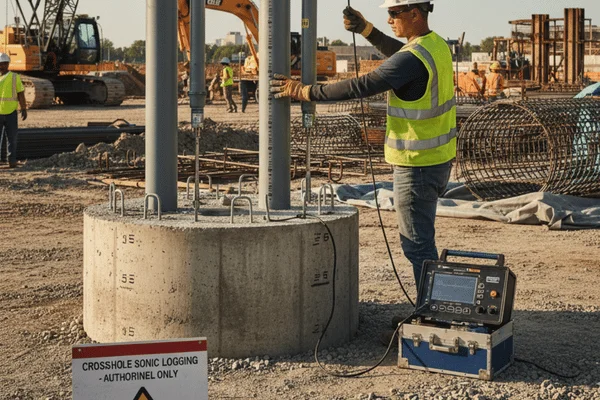
Some Soil Testing services include pile testing and concrete evaluation, which support foundation safety and structural reliability. These services work together with Soil Testing results to provide a complete picture of site conditions.
Soil Testing reporting is another important service. Clear Soil Testing reports help engineers interpret data and apply results to design plans.
Benefits of Professional Soil Testing
Professional Soil Testing provides several benefits for construction projects. One major benefit is improved safety. Soil Testing helps identify weak soil conditions that could lead to structural failure.
Soil Testing also improves design accuracy. Engineers can design foundations based on actual soil behavior instead of assumptions.
Another benefit of Soil Testing is cost control. Early Soil Testing reduces the risk of unexpected ground conditions during construction.
Soil Testing also improves project efficiency. With accurate Soil Testing data, construction planning becomes more predictable and organized.
Common Problems Avoided Through Soil Testing
Soil Testing helps prevent several construction problems. One common issue is uneven settlement. Soil Testing identifies soil layers that may compress unevenly under load.
Soil Testing also helps avoid foundation cracking. Poor soil conditions can cause structural stress, which leads to visible damage over time.
Another issue avoided through Soil Testing is drainage failure. Soil Testing identifies soil types that retain too much water, which may affect structural stability.
Soil Testing also reduces the risk of foundation shifting. Without Soil Testing, soil movement may go unnoticed until structural damage appears.
Takeaway
Soil Testing remains a fundamental part of safe and reliable construction. It provides essential data about soil strength, composition, and behavior, which directly affects foundation design and structural performance.
Accurate Soil Testing supports better engineering decisions, reduces construction risks, and improves long-term building durability. With proper Soil Testing, engineers can design structures that match actual ground conditions.
Accredited laboratories such as Inch-On Materials Testing Laboratory provide dependable Soil Testing services that meet ASTM and AASHTO standards, supporting safe and high-quality construction projects.
Frequently Asked Questions (FAQ)
What is Soil Testing in construction?
Soil Testing is the process of evaluating soil properties to determine strength, composition, and suitability for supporting structures.
Why is Soil Testing important before construction?
Soil Testing helps identify ground conditions that affect foundation design, structural safety, and construction cost planning.
What standards are used for Soil Testing?
Common Soil Testing standards include ASTM D1586, ASTM D422, and ASTM D4318, along with AASHTO guidelines.
What are the main types of Soil Testing?
Soil Testing includes field testing at the site and laboratory testing of soil samples under controlled conditions.
Who performs Soil Testing?
Soil Testing is performed by trained geotechnical specialists and accredited laboratories with proper equipment and procedures.
How does Soil Testing affect foundation design?
Soil Testing provides data that helps engineers choose suitable foundation types and prevent structural failure due to weak soil conditions.